
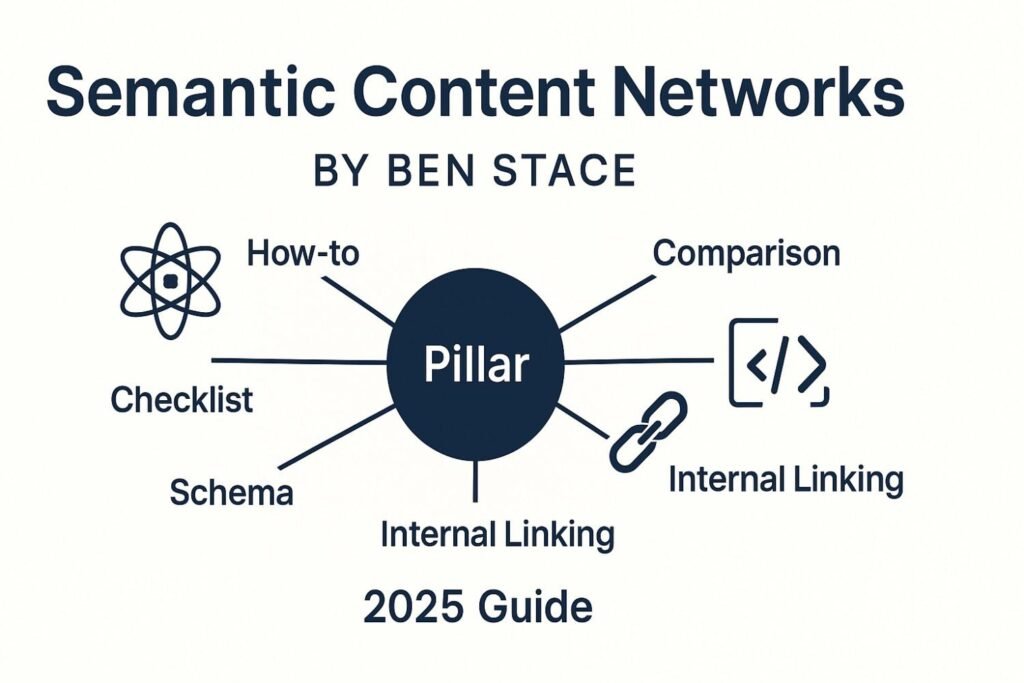
TL;DR: This no-fluff guide shows you how to build semantic content networks by Ben Stace in spirit: map entities, design a topic graph, publish a pillar-cluster set, wire intent-based internal links, add schema, and track wins with simple KPIs. Use the templates, table, and checklist below to ship in days, not months.
- Strategy: Plan around entities and search tasks, not just keywords.
- Structure: One pillar + 8–20 tightly scoped clusters + smart lateral links.
- Signals: Schema (Article/FAQ/HowTo) + breadcrumbs + descriptive anchors bolster topical authority.
- Measurement: Impressions, internal CTR from the hub, and # of cluster pages with clicks within 90 days.
What Is a Semantic Content Network (and Why It Works)?
A semantic content network is a purposeful web of pages built around entities (people, places, things, concepts) and intent (the tasks users want to complete). Instead of isolated posts, you design a topic graph with one pillar that explains the whole concept, surrounded by clusters that go deep on subtopics. This mirrors how modern search understands meaning and how readers navigate problems.
In SEO circles that reference the thinking associated with Ben Stace, the emphasis is on topic coverage, relationships, and clear navigation—not keyword stuffing. Done right, your network wins on intent satisfaction, internal discoverability, and entity clarity.
How to Build One: 7-Step HowTo
- Scope the topic with entities & tasks.
- List core entities, attributes, synonyms, and closely related concepts.
- Capture search tasks (learn/compare/do) and map each to intent.
- Deliverable: “Topic Graph” sheet with columns: Entity · Parent · Sibling · Intent · Stage · Content Type.
- Design the pillar and cluster plan.
- 1 definitive pillar (broad overview) + 8–20 clusters (each answering a single task or entity angle).
- Avoid overlap; every cluster should have a unique purpose.
- Create outlines that answer first, elaborate second.
- Answer the main question in the first 120 words.
- Use short paragraphs, H2/H3 every 200–300 words, tables, and diagrams.
- Write naturally with entity language and synonyms (topic clusters, content hubs, knowledge graph, topical authority).
- Draft, then wire internal links by intent.
- Hub → Cluster: From the pillar, link to all clusters with descriptive anchors (e.g., “ceramic vs composite fillings differences”).
- Cluster → Hub: Each cluster links back to the pillar (“full guide to …”).
- Cluster ↔ Cluster: Lateral links connect next steps in the journey (e.g., “After-care” ↔ “Pain management”).
- Add schema markup to reinforce meaning.
- Pillar:
Article+BreadcrumbList. Clusters:Article, plusFAQPageorHowTowhere suitable. - Ensure on-page FAQ text exactly matches FAQ JSON-LD.
- Pillar:
- Publish with clean UX and media.
- Readable design, compressed images (<150 KB), lazy-load, mobile-first formatting.
- Add at least one original visual (diagram, screenshot, or table) per key page.
- Measure, prune, and update.
- 90-day KPIs: impressions on entity phrases, average position for cluster heads, internal CTR from hub, % of clusters with clicks.
- Merge overlapping pages; expand FAQs from Search Console queries; refresh examples quarterly.
Information Architecture & Internal Linking
Keep URLs predictable and anchors descriptive. A simple, scalable map might look like:
/semantic-content-networks-by-ben-stace/           ← Pillar (overview)
/semantic-content-networks-by-ben-stace/entity-basics/
/semantic-content-networks-by-ben-stace/how-to-build/
/semantic-content-networks-by-ben-stace/internal-linking/
/semantic-content-networks-by-ben-stace/schema-guide/
/semantic-content-networks-by-ben-stace/tools-and-templates/
/semantic-content-networks-by-ben-stace/glossary/
| Page | Primary Intent | Key Entities | Required Links |
|---|---|---|---|
| Pillar (this page) | Informational overview | Semantic SEO, Entity, Knowledge graph, Topical authority | Links to all clusters; breadcrumb to Home |
| How-to build | Hands-on “do” | Topic map, Internal links, Schema | To Pillar; to Internal linking; to Schema guide |
| Internal linking | Support | Anchor text, Hub, Cluster | To Pillar; to How-to build |
Templates, Anchors & Publishing Checklist
Copy-Paste Topic Graph (starter)
Entity | Parent | Sibling(s) | Intent (info/compare/do) | Stage (learn/decide/do) | Content Type
------ | ------ | ---------- | ------------------------ | ----------------------- | ------------
[Core Concept] | [Category] | [Near Concepts] | info | learn | guide
[Process Step] | [Core Concept] | [Next Step] | do | do | how-to
[Variant A vs B] | [Core Concept] | [Alternatives] | compare | decide | comparison
[Checklist] | [Process Step] | [After-care] | do | do | checklist
[Pricing/ROI] | [Core Concept] | [Budget] | compare | decide | pricing
Anchor Text Cookbook
- What is [concept], step-by-step [task], vs [alt], pricing, checklist, after-care, tools, templates.
- Avoid repeating one exact anchor site-wide; rotate closely related natural phrases.
Pre-Publish Checklist
- Primary keyword appears in H1, intro, one H2, URL, and one image alt (once each).
- 2–4 internal links out from this pillar; 1–2 internal links in from existing posts.
- At least one original table/diagram/screenshot on the pillar and each major cluster.
- Author bio with credentials + “Last updated” date visible.
- Images compressed (<150 KB), lazy-loaded; mobile layout passes Core Web Vitals.
Mini Example: Local Dental Clinic
Pillar: Dental fillings (overview). Clusters: what are fillings, ceramic vs composite, after-care checklist, cost & insurance, tooth pain after filling.
- Every cluster links back to the pillar using descriptive intent anchors (e.g., “complete guide to dental fillings”).
- Lateral links connect decision steps (“ceramic vs composite” ↔ “cost & insurance”).
- FAQ schema on after-care; HowTo schema on the procedure page.
Common Mistakes to Avoid
- Keyword chasing without task mapping. Start with user jobs, then express them in entity terms.
- Overlapping angles. If two pages target the same intent, consolidate.
- Vague anchors. “Click here” communicates nothing; use intent-rich phrases.
- Schema spam. Only add FAQ/HowTo if the content truly matches the markup.
- Set-and-forget. Update clusters quarterly with new questions from Search Console.
FAQs
Is a semantic content network different from a silo?
Yes. A silo groups content by folder. A semantic network connects pages by meaning and task flow—even across folders—and uses schema and internal links to make those relationships clear.
How many cluster pages should I build?
Plan 8–20 around your pillar. Fewer than 6 often leaves gaps; more than 25 usually creates overlap unless the topic is very broad.
What’s the quickest way to start?
Draft the pillar outline, pick 6 high-impact clusters (what is, vs, pricing, checklist, how-to, mistakes), publish, then add 2–4 clusters per week.
How fast can results show up?
Most sites see impression lift in 2–6 weeks and steadier ranking gains by 8–12 weeks, assuming good interlinking and regular refreshes.
Next step: Want a done-for-you topic graph and internal linking map tailored to your niche? Book a free 15-minute review.