
TL;DR: A Ben Stace–style topical map turns scattered posts into a connected content network. Define entities, cluster subtopics, apply consistent internal links, add matching schema, and refresh quarterly. Do this and you’ll grow breadth, depth, and trust—fast.
What is a topical map (Ben Stace style)?
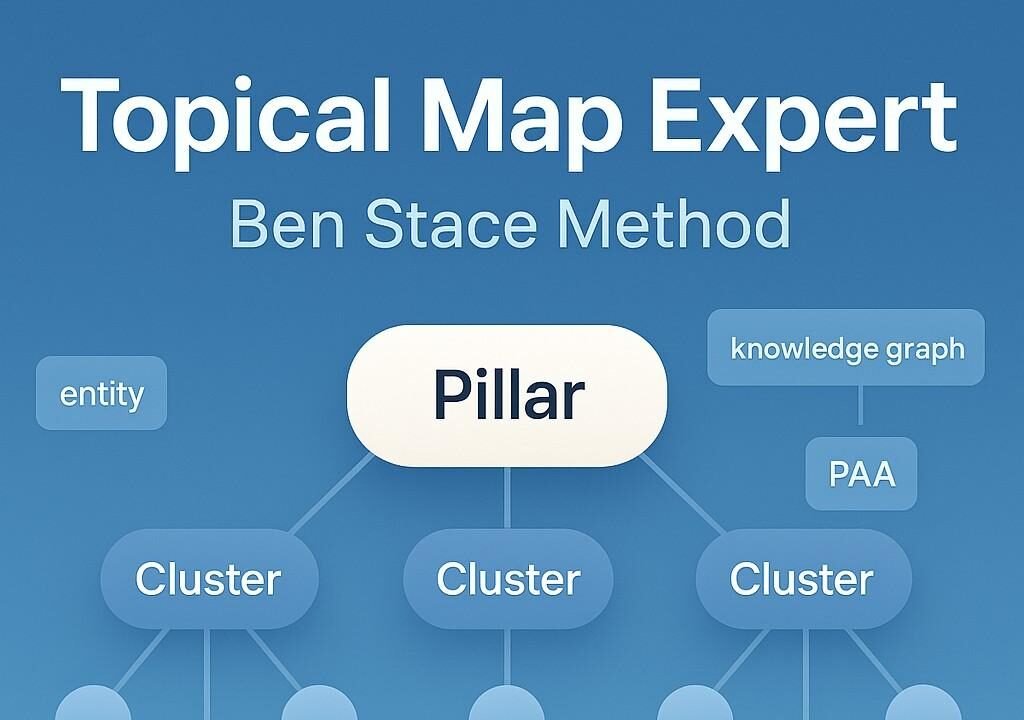
A topical map is a structured blueprint for a subject: pillar → clusters → supporting nodes, connected by purposeful internal links and matched to user intent. The Ben Stace flavor emphasizes (1) entity-first research, (2) coverage by intent (learn, compare, choose, buy), and (3) network thinking—pages that explain, reinforce, and escalate one another.
Why it matters for rankings
- Coverage breadth: Entities and subtopics are mapped before writing, so you miss fewer angles and capture more queries.
- Depth & trust: Interlinked clusters signal topical authority, improving crawl paths and dwell time.
- Snippet wins: PAA-style H2/H3s and 40–60 word answers boost featured-snippet and “People Also Ask” visibility.
- Faster growth: Shipping pillar + clusters together accelerates indexing and internal discovery.
The 8-step framework
1) Define the outcome & ICP
Write a one-line goal: “Own the [head topic] entity set for [ICP] to drive [demo/lead/trial] conversions.” This anchors scope and CTAs.
2) Seed entities and subtopics
List the core entity (Topical map) and 20–40 related entities: semantic SEO, knowledge graph, content cluster, content hub, pillar page, anchor taxonomy, FAQ schema, HowTo schema, PAA, search intent, internal linking, crawl depth, query spread, E-E-A-T.
3) Map SERP archetypes (formats that win)
Note what ranks: definitions, checklists, templates, calculators, case studies. Your cluster mirrors and improves those formats—not fights them.
4) Architect the cluster
- Pillar: the definitive overview linking to every cluster page.
- Clusters (6–20): subtopics that fully explain the pillar.
- Supporting: glossary, troubleshooting, comparisons, buyer’s guides.
5) Draft internal link rules (before writing)
Each new page must link up to the pillar (descriptive exact-match), sideways to 2–3 siblings (related anchors), and down to supports (long-tail anchors).
6) Write briefs that force coverage
- PAA-style H2/H3s with 40–60 word snippet answers.
- Required entities list + example anchors to use.
- Primary/secondary CTA aligned to the reader’s intent stage.
7) Add schema that matches purpose
Article for essays, HowTo for procedures, FAQPage for Q&A. Only add what’s truthful to the content.
8) Ship, measure, refresh
Publish in sprints (pillar + 3–5 clusters). Track impressions, query diversity, crawl depth, and coverage vs. your entity checklist. Refresh weak intents quarterly.
Internal link taxonomy that scales
- Up links (child → pillar): “topical map framework”, “semantic content hub”.
- Side links (cluster ↔ cluster): “entity research”, “intent modeling”, “anchor taxonomy”.
- Down links (→ supports): “PAA extraction process”, “FAQ schema examples”.
- Utility links: glossary, templates, calculators, case studies.
Rule of 3: Every page must ship with one up, one side, and one down link.
Schema you should actually ship
Match schema to what’s on the page. Example HowTo (trim or extend steps to fit your doc):
{
  "@context": "https://schema.org",
  "@type": "HowTo",
  "name": "Build a Topical Map (Ben Stace Style)",
  "step": [
    {"@type":"HowToStep","name":"Seed entities","text":"List 20–40 related entities grouped by intent."},
    {"@type":"HowToStep","name":"Cluster","text":"Plan pillar, 6–20 clusters, and supporting content."},
    {"@type":"HowToStep","name":"Interlink","text":"Up, side, and down links with consistent anchors."},
    {"@type":"HowToStep","name":"Ship & refresh","text":"Publish in sprints and update quarterly against gaps."}
  ]
}
Example content brief (copy & adapt)
- Primary keyword: topical map expert ben stace
- Intent: informational → commercial investigation
- Persona: SEO lead or founder seeking repeatable topical authority
- Must-cover entities: topical map, semantic SEO, entity, knowledge graph, content cluster, content hub, anchor text, PAA, FAQ schema, internal linking
- Suggested H2s: what it is, framework, interlinking, schema, brief, checklist, case study, FAQ
- CTA: download checklist or book a strategy call
Publisher checklist
| Item | Done? |
|---|---|
| H1 contains primary keyword once | ⬜ |
| PAA-style H2/H3s + 40–60 word answers | ⬜ |
| Entity list covered across pillar & clusters (≥90%) | ⬜ |
| Rule of 3 internal links (up/side/down) | ⬜ |
| Article + FAQ (+ HowTo if procedural) | ⬜ |
| Feature image 1280×720 with descriptive alt text | ⬜ |
| Slug short and hyphenated | ⬜ |
| Meta title ≤60, description ≤160 | ⬜ |
| Updated on date & author bio present | ⬜ |
Mini case study (anonymized)
Baseline (Day 0): 1 pillar + 2 scattered posts; ~40 daily impressions; 6 keywords in top 20.
Action: Built entity list (28 items), shipped pillar + 7 clusters in one sprint, enforced Rule of 3 links, added FAQ/HowTo schema, refreshed titles for “problem → outcome.”
Day 60: ~3.1× impressions; 34 keywords in top 20; 4 featured snippets; lead volume up 22%. Note: results vary by niche and competition, but networked coverage consistently outperforms isolated posts.
Get the Topical Map Starter Kit
Download the entity checklist, anchor taxonomy sheet, and a cluster planning template.
FAQ
Is a topical map different from keyword research?
Yes. Keyword lists are flat; a topical map is a connected model of entities, intents, and internal links. Keywords still matter—they attach to the entity structure.
How many cluster posts do I need to start?
Launch with a pillar + 6–12 clusters and 3–5 supports. Expand based on entity gaps and intent coverage, not arbitrary counts.
Do I need backlinks for this to work?
Backlinks help, but strong internal networks win surprising ground—especially in mid-competition spaces—by satisfying breadth, depth, and intent better than isolated content.
How often should I refresh the map?
Quarterly. Add new PAA questions, prune or merge thin pages, and update anchors to reflect emerging phrasing in your queries.